
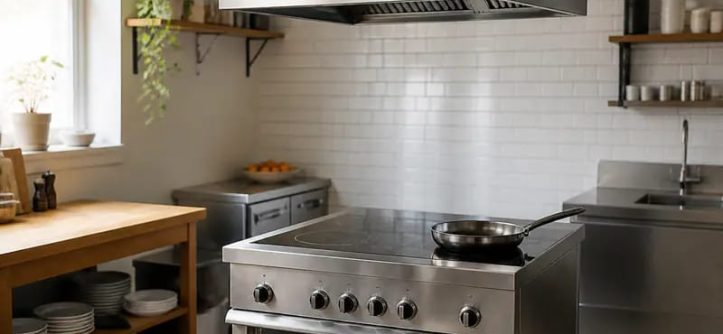
A cafe owner can turn off the gas for the first morning of their new induction range and expect the room to feel slightly cooler than normal. However, interviews with commercial kitchen extraction experts in the latest Foodservice Equipment Journal feature reveal that there will be very little difference in reality. The original is Foodservice Equipment Journal’s interviews on commercial kitchen extraction, and it’s worth reading in full.
The same whole-system approach to commercial kitchen extraction applies, i.e. capture, replacement air and odour control, but with the gas interlocks being dropped as they are no longer required.
A small café goes all-electric
First design choice: a small café or takeaway with a new induction line and no ducting for a conventional kitchen extraction system. Some heat reduction would be hoped for with an all-electric kitchen but this is only the starting point for serious consideration of a proper solution to ventilation requirements for your new kitchen.
What induction really takes out of the room
By choosing a commercial induction range, the products of combustion are eliminated along with the majority of the radiant heat. Therefore, there is no longer a need to worry about carbon monoxide in the kitchen, and gas interlocking can be scrapped. However, a busy line can pull some heavy electrical loads, and so it is worth considering demand-controlled fans.
Grease, steam and odour stay
Pans will still produce grease aerosol and steam. Workplaces where heat stress can occur are listed in HSE’s heat stress guidance. These include catering kitchens. As well as measuring air temperature in kitchens, work rate, humidity and the type of work clothing worn by staff all need to be taken into account when assessing the risk of heat stress. A cooler wall thermometer in the kitchen does not mean that staff will feel cooler on busy shifts.
Where ventless setups still need air
A recirculating or ventless system will often be the only option for a small site with no possibility of a duct out. David Pedrette, founder of Target Catering Equipment and commercial kitchen ventilation specialist, advises keeping it safe and simple and capturing cooking by-products effectively. In a tiny induction kitchen the room should be designed for the treated air and the steam from cooking to go out via fresh air supply into the room.
Neighbours smell cooking, not fuel
The noise from the cooking activity and the smell of food being cooked will also need to be considered as potential triggers for complaints in accordance with s80, and could result in a statutory nuisance abatement notice being served with the potential for prosecution and fines if the complain is ignored (GOV.UK, 2024).
Where the feature’s advice holds and bends
The advice holds where a kitchen is designed around its menu, number of covers served and hours of operation. It also holds for heat, replacement air and short duct runs. It holds for TR19 cleaning of ductwork, and bends where gas interlocks are omitted from an all-electric design and where induction reduces heat but humidity remains.
As the chef adds treated air to the air in the kitchen, that same air has to be removed from the kitchen and either dispersed at ground level, vented over the roof or extracted via fresh air entering the kitchen.




Leave a Reply