
A blockage in a drain is one of those simple problems that tend to reveal themselves at the worst time. Until you are left frantically trying to clear up a mess of water in your kitchen at 9pm at night, it’s hard to appreciate just how complex a problem a drain blockage is. However, once you have an idea of what a drainage expert does and how they do it, the process is actually much less of a problem than you might have imagined.
Spotting a real blockage
A slow draining sink, bath or shower is different from a full blockage. A slow draining sink, bath or shower means that there is a partial blockage in the drain but water does flow through. A blockage means that there is a full blockage in the drain and water will not flow at all. A full blockage will eventually overflow at the lowest point in the system i.e. an outside gully or the lowest toilet. Smells from a manhole cover or outside gully are usually an indication of rotting matter further down in the drain and can cause a full blockage.
Trying a plunger or hand auger
For single fixtures such as sinks, baths and toilets, it is generally best to attempt to clear blockages with a plunger first. This should be done in the normal way of plunging down to attempt to create suction to clear blockages. If this fails, a hand auger (drain snake) can be used to attempt to retrieve hair or other objects that have become stuck in pipes just beyond the sink trap. Again, it is worth remembering that attempts to clear a blockage should be made with reasonable force, and that once it is clear that a blockage cannot be shifted in this manner then no more attempts should be made in case more damage is caused.
How drain rods work
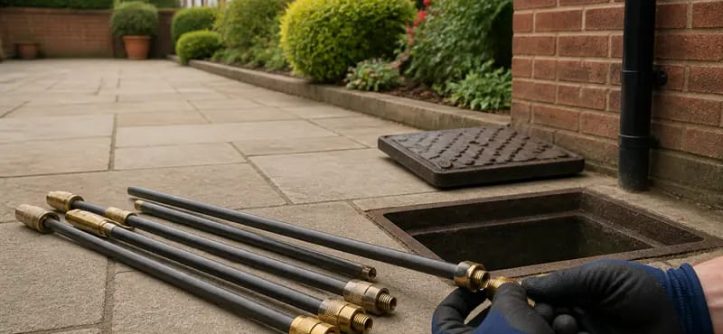
Rodding involves the use of a long cable, which is screwed together in sections, to physically push through the blockage. The amount of pressure that is required will depend on the individual situation and the location and type of joint in the pipe(s) that are affected. It is easy to crack a joint between sections of a pipe by using too much pressure and once a joint has been cracked, the wastewater from the property can escape out into the ground and this will be an environmental pollution incident.
What high-pressure jetting does
Whilst rodding aims to shift a single blockage, high-pressure water jetting is often used to clear blockages caused by grease and silt building up as a thick layer on the inside of drains. By using high-pressure water hoses and jetting nozzles of various sizes and types, the inside of the drain is scoured to remove the stubborn silt and grease which has built up over time. This type of work is quite different to that of rodding, as rather than trying to move an obstruction, the hose is used to actually strip the silt and grease from the drain walls. See also Drain Unblocking Company. There is published guidance on guidance on what not to flush that covers this in more detail.
Why a camera check matters
A CCTV drain survey can then be conducted after the drain has been cleared to identify if there are any more problems further down the drain and to establish what caused the blockage in the first place. This can highlight any structural problems with the drains, root intrusion, collapses or even show up how a particular blockage has caused a buildup of matter within the drain and why it caused a blockage at that particular point.
Roots versus grease buildup
Roots and grease both cause similar problems with your drainage, causing slow flow and then a full blockage. But their solution is very different. Roots in pipes are generally cut mechanically, sometimes with special root cutting heads on the jetting hose. Sometimes the whole pipe may need relining or even repair depending on the roots entry point. Grease on the other hand forms slowly as a thick paste-like substance building up on the walls of pipes. This type of blockage is usually cleared by high-pressure jetting.
Access points and garden disruption
A drain clearance typically starts by accessing the drain externally via a manhole cover or other external access point. Our experience is that 95% of drains can be cleared without having to disturb your garden. For most properties this is in the front or rear of your home, often in a garden, sometimes under a path or covered driveway. We also have to determine whether the section of drain affected is your responsibility or that of the water company. Under the wastewater and drainage services rules shared sewers beyond your boundary are typically maintained by the water company.
Habits that reduce future blockages
Most blockages happen time and time again due to a small number of very common practices that, as stated by water companies, you should never flush down the drain. This includes fat and cooking oil (left to cool down first), wipes and sanitary products as well as food scraps down the plughole. Simple practices that prevent majority of repeat call-outs include letting fat cool down in order to put it in the bin, using a simple sink strainer and monitoring a drain for slow emptying prior to it blocking completely.
If you understand what you’re paying for in a drainage emergency, you’ll find that a blocked drain is a lot less worrying than you might have imagined.



Leave a Reply