
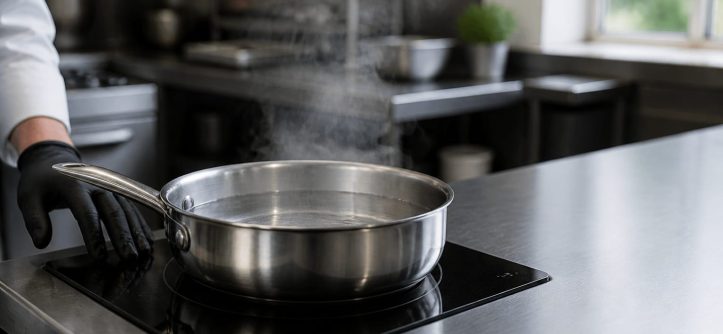
It’s becoming more and more apparent why many catering businesses are switching from gas to induction for their commercial kitchens. We take a look at the reasons behind this change and why so many chefs are now choosing to use this versatile piece of equipment.
Faster Boil And Response Times
It is able to get water to boiling point in about half the time of a gas burner, which is because the heat is generated directly in the bottom of the pan rather than having to heat up the air in the pan and then up to the top before it can start to cool. Once maximum temperature has been reached reducing the heat has the same almost instant effect as it would with gas.
Cooler Kitchens During Service
For a Commercial Kitchen the temperature of the air around the range is significantly lower than for gas. This means that the impact of the heat on your ventilation system is lower and therefore requires less extraction. In addition the heat from induction ranges does not rise to the ceiling of your kitchen so your air conditioning will be less affected. In summer this is particularly welcome because of the stifling hot line temperature that can be created by gas ranges.
Lower Running Costs Over Time
Whilst it won’t make massive savings overnight, the energy efficiency of induction cooking does start to have a positive effect on the bottom line of a commercial kitchen very quickly. Typical efficiency for induction cooking is around 85-90% of the input energy actually being used for cooking. This compares to around 40-55% for gas. As a commercial kitchen would typically operate for 12 hours+ a day and run multiple cooking stations, this efficiency gap is soon translated into real savings on energy bills.
A Safer Cooking Surface
Induction cooking surfaces don’t have an open flame, and there is no pilot light to burn continuously when not in use. Moreover, the cooking area itself remains cool to the touch. When a cooking vessel is removed from the surface of the range, the appliance automatically switches off the relevant zone(s). According to the Health and Safety Executive’s guidance on the safe use of catering equipment, burns, fires and gas-related incidents remain a major hazard in commercial kitchens. In addition to these potential problems, induction can help to reduce them.
Simpler Cleaning Between Services
A flat glass-ceramic surface is easy to clean, a simple wipe with a cloth between sittings. The lack of burners, grates or trivets to lift off means there is no chance for spills to drip into burner wells or to pool in the bottoms of grates. In commercial kitchens, surfaces must be able to be kept clean and free of residue, not just looked clean between sittings.
Precise, Repeatable Temperature Control
The precision of temperature with induction cooking is another major advantage over gas. The temperature of a sauce or other dish can be easily and accurately controlled with an induction cooker. It is also very useful for reheating dishes of the same type and ensures that they are always cooked to exactly the same standard.
Flexible Layouts Without New Gas Work
Because a Commercial Induction Range requires only a connection to a supply of electricity, adding a cooking station or moving one is a matter of plugging in. You don’t have to get in new pipework and have a visit from the Gas Safe engineer to test it for safety before it can be used. In time, the ability to move a cooking station around as you see fit can prove to be particularly advantageous in restaurants with changing kitchen layouts.
Easier Insurance And Compliance Conversations
Although gas is by no means an obsolete product, fewer open flames and lower fire risk are major considerations for insurance providers and local authorities who have to deal with kitchens that are open for extended periods of long, busy services. In the end, all providers of catering equipment are asked to consider three important questions: cost, savings and risk.
It doesn’t mean that gas ranges are going to become obsolete but from a speed, cost, safety and flexibility perspective, the commercial induction range answers more of the questions better than most other ranges on the market today.




Leave a Reply