
This article outlines some of the more common misconceptions that are associated with Drain Surveys. In some cases, the confusion as to what is involved in a Drain Survey has led to people avoiding them when they would clearly be of benefit.
Myth a camera only spots blockages
Most people expect a drain camera survey to simply confirm that a pipe is blocked, before they even agree to the survey. But what they find out is that the actual footage of the inside of the drains can reveal many more problems. Not only can it reveal blockages, but also signs of wear and tear such as cracks running along the sides of pipes, tree roots entering through joints, misalignment of sections of pipe and even collapse of the pipe where it has completely lost its shape.
Myth the garden has to be dug up
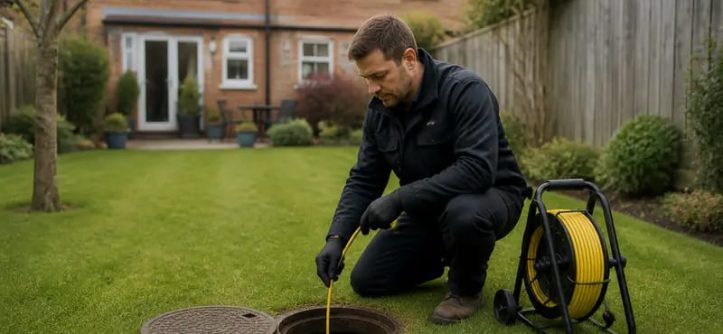
Another Drain Survey myth is that the whole of your garden will have to be dug up for the CCTV Drain Survey. This is not the case. The Drain Survey camera enters the drain via existing external access points. i.e. manholes, external gullies or rodding eyes. Only if problems are found with the Drain Survey, may subsequent works be required to excavate sections of your garden. But not for the survey itself!
Myth every drain camera does the same job
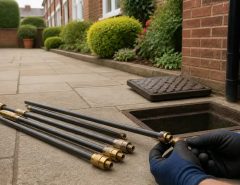
This is not always the case as some lateral drains are smaller than others and therefore require a smaller camera. Often shorter, domestic-type laterals are inspected with a push-rod camera, typically on a semi-rigid rod, whereas larger diameter laterals and longer lengths are better inspected with a crawler style camera on wheels with a pan-and-tilt head, allowing access to inspect up side junctions for example.
Myth the report is just a video clip
Typically a written log of all defects found would be produced during the survey. This would detail the exact location of each defect in relation to the start of the survey, plus a simple diagram highlighting the route of the drains and the location of any problems found.
Myth a clear running drain means nothing is wrong
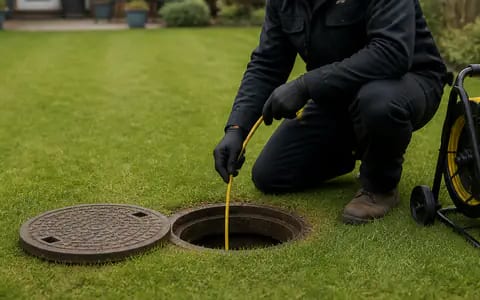
The drains empty well. No problem here. But what about a crack down one side of a long section of pipe? Gradual wash away of ground around the exterior of a drain? Or even slow fill by root mass? These early stage defects can be located and confirmed by a drain survey before any blockage is encountered.
Myth only old Victorian pipework needs checking
Modern plastic drains are not necessarily better than older clay or brick pipes and can have their own set of problems. For example, newly installed pipes can be poorly jointed or have left in them builders’ debris or even offcuts of pipe. Also new pipes can be damaged by nearby excavation or even by machinery during groundworks for a new extension or driveway.
Myth it is an all day disruptive job
On average a drain survey for a domestic property takes less than an hour to complete. A CCTV drain survey typically uses existing external access points, for example a manhole, an external gully or a rodding eye, all of which are situated near to the property. There is no need for anyone to enter your home. In a business context, the perceived disruption of a drain survey will probably be the biggest drawback to many businesses, but in reality it is actually the smallest part of the overall process.
Myth whatever is found is automatically the water company’s problem
Of all the myths there’s probably one that will cause the most confusion. That being as to who is responsible for maintenance for defects found within a drain. In 2011 the majority of lateral drains and sewers were transferred from private ownership to be maintained by the water company, however there are many exceptions to this rule. The point at which a private drain becomes a public sewer is clearly defined in law, however in practice this can be very complex and often depends on the individual property. Ofwat have produced a number of documents detailing which sewers have been adopted by the water industry. It is always worth checking to see if the sewer that you are responsible for is now the water companies. A properly produced CCTV survey report will highlight the location of defects within the drainage system and clearly mark the distance from the point of entry for the CCTV camera, enabling both yourself and the water company to clearly understand where responsibility for any repairs lies. There is more on CCTV Drain Surveys at Wilkinson Environmental now part of Ipsum Water.
A survey using a camera is an investigation into your drains that do not require any digging. Most of the myths surrounding CCTV drain surveys are not true and it is best to clear up any misconceptions before booking a survey.



Leave a Reply