

If you own or manage real estate in the United States, you have probably come across two types of software that sound remarkably similar. One handles your tenants and leases. The other tracks your returns and investors. Choosing the wrong one can cost you time, money, and significant headaches. Understanding which tool fits your role is the first step toward making a smart decision.
This article breaks down the core difference between these two software categories, explains who uses each one, and helps you decide what your business actually needs.
The Core Distinction: Operations vs. Strategy
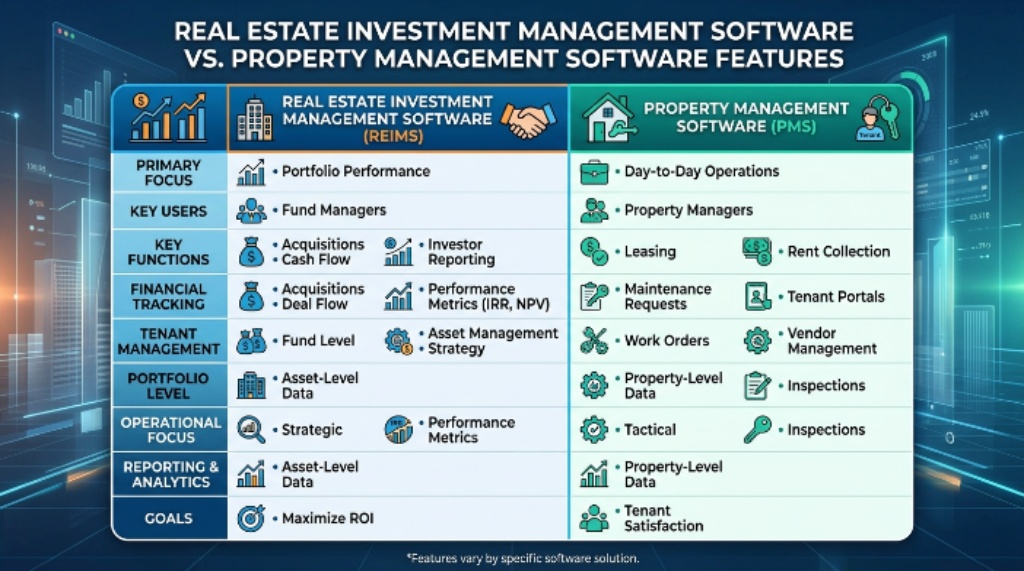
The simplest way to understand the difference is this: one tool runs the building, and the other manages the investment.
Property management software handles the day-to-day work of running a physical property. It tracks tenants, collects rent, coordinates maintenance, and manages leases. It is built for the people whose job is to keep buildings occupied and running smoothly.
Real estate investment management software, by contrast, handles the financial strategy behind owning properties. It tracks portfolio performance, manages relationships with investors, analyzes returns, and guides decisions about buying, holding, or selling assets. It is built for the people whose job is to grow capital and report results to stakeholders.
Both types serve the real estate industry, but they serve entirely different functions within it. Using one where you need the other is like using a speedometer to measure fuel efficiency. They live in the same vehicle, but they answer different questions.
What Property Management Software Does
Property management software is the operational backbone of rental real estate. It is used by landlords, property managers, leasing agents, and residential management companies across the country.
The core features of a typical US platform include:
- Tenant screening and application processing
- Online rent collection and late fee tracking
- Lease creation, storage, and renewal management
- Maintenance request intake and vendor coordination
- Tenant communication portals and messaging
- Owner reporting and distribution tracking
- Vacancy marketing and listing syndication
- Trust accounting and reconciliation
Platforms like AppFolio, Buildium, Yardi Breeze, Rent Manager, and DoorLoop lead this market in the United States. Pricing varies considerably by scale. DoorLoop starts at around $49 per month for up to 20 units. AppFolio runs approximately $1.49 to $5 per unit per month depending on the plan. These tools make sense for property managers who oversee residential or commercial buildings and need everything in one organized system.
The focus is transactional and operational. The software answers daily questions like: Who paid rent this month? Which unit has a maintenance request? When does this lease expire? It is built for speed, compliance, and operational consistency.
What Real Estate Investment Management Software Does
Real estate investment management software operates at a higher strategic level. It is used by asset managers, real estate fund operators, general partners, limited partners, family offices, and institutional investors.
Rather than tracking which tenant is in which unit, this software tracks how each asset in a portfolio is performing financially. It connects financial data, investor records, and capital flows into a single system that helps investment teams make decisions and report results with confidence.
Core features of investment management platforms in the US typically include:
- Portfolio-level financial modeling and performance analytics
- Internal rate of return (IRR) and equity multiple tracking
- Investor relationship management and communication tools
- Capital raise and fundraising workflow management
- LP investor portals with self-service document access
- Automated distribution processing for GPs and LPs
- Deal pipeline tracking and acquisition analysis
- Regulatory compliance and audit trail documentation
- Fund-level reporting and consolidated financial statements
Leading platforms in this category include Yardi Investment Manager, AppFolio Investment Manager, Argus Enterprise, and Juniper Square. Enterprise solutions like Yardi Voyager Investment Manager are custom-priced, with first-year implementation costs often ranging from $25,000 to over $500,000, depending on portfolio complexity and organizational size.
AppFolio Investment Manager holds a strong market position in 2026, earning a 4.5 out of 5 on G2 and 4.7 out of 5 across Capterra, Software Advice, and GetApp. It uses AI-powered tools including Smart Compose for investor communications and Alpha Asset Management dashboards for performance tracking. Argus Enterprise remains the industry standard for institutional property valuation and commercial real estate financial modeling.

Side-by-Side Comparison
| Feature | Property Management Software | Investment Management Software |
| Primary user | Property manager, landlord, leasing agent | Asset manager, fund operator, GP, LP |
| Main focus | Daily operations of physical properties | Portfolio returns and investor capital |
| Rent collection | Yes | No |
| Maintenance tracking | Yes | No |
| Tenant communication | Yes | No |
| IRR and return modeling | No | Yes |
| Investor portal | No | Yes |
| Capital raise management | No | Yes |
| Distribution processing | Basic owner distributions | Multi-tiered GP and LP waterfall distributions |
| Deal pipeline tracking | No | Yes |
| Financial reporting level | Property-level | Fund and portfolio-level |
| Example US platforms | AppFolio, Buildium, Yardi Breeze, DoorLoop | Yardi Investment Manager, Argus, Juniper Square, AppFolio Investment Manager |
| Typical user scale | Individual landlords to large property managers | Investment firms, REITs, family offices, institutional funds |
Who Needs Which Tool?
The answer depends on your role in the real estate ecosystem.
You need property management software if you are a landlord managing rental units, a property management company overseeing residential or commercial portfolios, a leasing agent handling tenant relationships, or an owner who wants to track rent, maintenance, and occupancy in one place.
You need real estate investment management software if you are a general partner managing a real estate fund, an asset manager responsible for portfolio returns, an investment firm reporting to limited partners, a family office tracking real estate holdings alongside other asset classes, or an institutional investor allocating capital across multiple property types.
Some professionals need both. A firm that both manages properties and raises capital from outside investors will typically run a property management platform for operational work and a separate investment management platform for fund administration and investor reporting. Increasingly, platforms like Yardi and AppFolio are building integrated stacks that connect both layers. However, these are usually sold and priced as separate modules.
Where the Overlap Happens
The boundaries between these two categories are not always clean. This is worth understanding before you evaluate any platform.
Many property management platforms include basic investor or owner reporting features. AppFolio and Buildium both offer owner portals that display property-level financial summaries. However, these features are designed for individual property owners, not for fund managers reporting to dozens of limited partners with complex waterfall distributions.
Similarly, some investment management platforms pull operational data from property management systems to generate portfolio-level analytics. Yardi’s full enterprise stack connects operational property data with investment reporting, but the two modules serve separate functions and typically require separate implementation.
Therefore, when a vendor claims their platform handles both needs, always ask specifically which tasks each module handles and how the two systems communicate. The distinction between a basic owner distribution report and a true multi-tiered LP waterfall is significant.
The US Market in 2026
The real estate investment management software market is growing rapidly in the United States. It is projected to reach $12.8 billion by 2028, growing at approximately 14.2 percent annually. That growth reflects how much pressure investment teams face to deliver returns, communicate transparently with investors, and manage increasingly complex portfolios.
Additionally, the property management software market is consolidating. Buildium is now part of RealPage. Redfin merged with Rocket Mortgage. These combinations create integrated ecosystems where search, financing, and operations share a common platform. For buyers evaluating software, this means the full ecosystem matters more than any single feature.
AI is also reshaping both categories. Property management platforms now use AI for automated maintenance triage, predictive vacancy analysis, and smart tenant screening. Investment platforms use AI for underwriting automation, portfolio performance alerts, and automated investor communications. Firms that rely on fragmented, disconnected tools are falling further behind those using unified, AI-powered platforms.
Conclusion
Real estate investment management software and property management software solve two very different problems. Property management software runs the daily operations of physical buildings: rent, leases, maintenance, and tenants. Investment management software handles the financial strategy behind the assets: portfolio performance, investor relations, capital deployment, and fund reporting. In the US market, the leading platforms in each category are purpose-built for their respective roles and are not interchangeable. Some firms need both, and leading vendors are building integrated stacks to bridge the gap. Before selecting any platform, identify whether your primary need is operational efficiency, investment intelligence, or both, and then evaluate accordingly. The right tool for your specific role will save time, reduce risk, and give you the reporting clarity your stakeholders expect.
Frequently Asked Questions
Can one software platform handle both property management and investment management?
Some vendors, including Yardi and AppFolio, offer separate modules that can be integrated to cover both operational and investment functions. However, these modules are distinct products with different pricing and user bases. A single platform rarely handles both functions equally well. Most firms that need both will use a specialized solution for each layer and integrate them.
Which type of software is right for a small landlord with fewer than 20 units in the US?
A small landlord managing residential rental units in the United States typically needs property management software. Tools like DoorLoop, starting at around $49 per month for up to 20 units, offer rent collection, lease management, and maintenance tracking at an accessible price point. Investment management platforms are generally designed for larger organizations managing outside investor capital.
What is an LP investor portal, and which type of software provides it?
An LP investor portal is a secure online platform that allows limited partners in a real estate fund to access their financial statements, track distributions, review investment performance, and sign documents electronically. This feature is found in real estate investment management software, not in standard property management platforms. Examples include Yardi Investment Manager’s branded investor portal and AppFolio Investment Manager’s investor engagement tools.
Is Argus Enterprise a property management tool or an investment management tool?
Argus Enterprise is a real estate investment management and valuation tool, not a property management platform. It is widely used in the US commercial real estate industry for institutional-grade asset valuation, cash flow modeling, and investment analysis. It does not handle day-to-day operational tasks such as rent collection or maintenance tracking.
How does AI affect real estate software in 2026?
AI is reshaping both software categories in different ways. Property management platforms use AI for predictive maintenance scheduling, automated tenant screening, smart vacancy alerts, and AI-assisted lease renewals. Investment management platforms use AI for automated investor communications, portfolio performance dashboards, underwriting automation, and capital allocation analysis. Firms using AI-integrated platforms are reporting measurable improvements in operational efficiency and decision-making speed compared to those using fragmented legacy tools.




Leave a Reply