
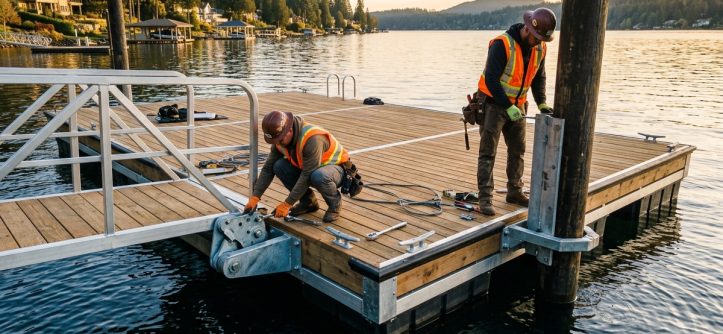
A floating dock will always move some. That is part of how the system works. The goal is to keep that movement controlled so the dock does not swing, twist, bounce, or feel unstable every time a wake rolls through. Good floating dock builders look at anchoring, flotation, frame stiffness, hinges, gangway connections, and site exposure before deciding how to steady the structure.
Getting the Anchoring Dialed in so Your Dock Doesn’t Swing Every Time a Wake Hits
Anchoring is usually the first place builders look when a dock moves too much. The system has to hold the dock in position while still allowing enough freedom for changing water levels.
Too much slack can let the dock wander. Too little can put unnecessary stress on hardware and connection points. The right setup depends on water depth, bottom conditions, wind, wave exposure, and seasonal changes. A dock on a protected cove may need far less restraint than one facing regular boat traffic.
Spud Poles vs. Stiff Arms vs. Cables: What Actually Holds a Dock Steady?
Different waterfronts call for different restraint systems. Spud poles can limit side-to-side travel where depth and bottom conditions allow their use. Stiff arms connect the dock to a fixed point and can control lateral movement. Cable systems offer another approach where the dock needs more freedom to rise and fall.
A boat dock builder should match the anchoring method to the property instead of using the same setup everywhere. Shoreline shape and exposure matter just as much as dock size.
Spreading out the Floats so You Don’t Get That Awful Seesaw Feeling When Walking
Float placement directly affects how a dock feels underfoot. If flotation is concentrated in the wrong spots, one side can dip noticeably when someone walks across the deck or places a heavy cooler near the edge.
On an aluminum floating dock, builders consider the frame shape, deck area, expected traffic, and accessory placement. Spreading support where loads actually occur helps keep the dock more balanced. It can also reduce excessive pitching as people move between connected sections.
Why Rigid Aluminum Truss Frames Prevent the Dock from Twisting in Rough Water
The frame has its own job in controlling movement. A stiff aluminum structure can resist unwanted flex between connection points while still working with the floats and anchors below it.
Truss-style framing can provide stiffness across longer sections without relying only on heavier material. Buyers comparing aluminum docks should look at bracing, weld quality, and frame geometry rather than assuming that a thicker-looking frame is automatically better.
How Dock Builders Use the Gangway Connection As a Built-in Stabilizer
A gangway mainly provides access, but the way it connects to shore can also influence dock movement. A properly designed shore connection may help control some lateral travel while still letting the floating section rise and fall.
That balance matters. A connection that is too rigid can transfer unwanted loads into hinges or shore-side supports as water levels change. Floating dock builders usually consider the gangway as part of the entire movement system instead of treating it as a walkway added after the dock is finished.
Upgraded Hinge Pins and Bushings That Stop Side Sway Without Rattling All Day
Hinges need room to move, but excessive play can create side sway, noise, and a loose feeling between sections. Well-fitted pins, bushings, and connection hardware can reduce unnecessary movement without preventing normal articulation.
These are small components, yet they take repeated loads every day. People shopping for aluminum boat docks for sale should ask how dock sections connect and whether hinge parts can be inspected or replaced easily. A good connection should move where it is supposed to without feeling sloppy.
Adding Underwater Deadweights to Pin down Floating Docks in Wide-open Water
Some sites use underwater deadweight anchors as part of the restraint system. These rely on substantial weight placed on the bottom and connected back to the dock through chain, cable, or similar hardware.
The amount of weight and its placement should not be guessed. Water depth, bottom type, wind exposure, dock size, and local requirements can all affect the design. In open water, builders may also use more than one anchoring method to control movement from different directions.
Dock stability usually comes from several parts working together rather than one oversized anchor or extra-stiff connection. Flotation Systems reduce unwanted dock movement by combining heavy-duty aluminum construction with specialized anchoring and bracing. Engineered with robust frames and diagonal bracing, these docks minimize natural sway and flexing in high-traffic or rough waters. For floating systems, they offer various technical anchoring solutions—such as rigid stiff-arms, heavy cables, and sturdy pole sleeves—designed to absorb wave energy and eliminate side-to-side drifting. This deliberate engineering ensures that both floating and stationary docks remain incredibly stable, secure, and safe under foot, even when facing changing water levels and unpredictable environmental conditions.




Leave a Reply